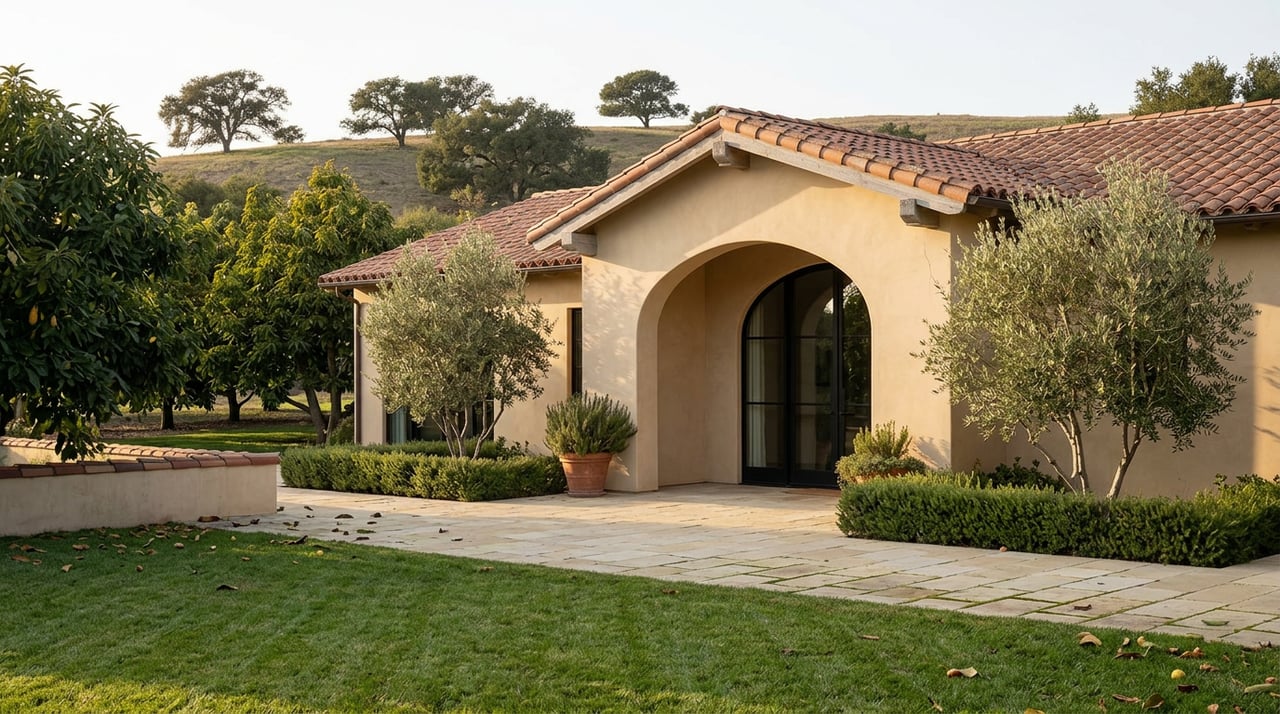
What happens when you call the county about the walnut orchard running its wind machines at 3 a.m., three months after you closed on your new home in Santa Rosa Valley?
Nothing happens. Not because no one is listening, but because the law was built specifically so that call goes nowhere.
That is the piece most buyers miss when they sign the agricultural disclosure that comes with almost every estate lot in Camarillo's unincorporated fringe: Santa Rosa Valley, Spanish Hills Country Club, Las Posas Estates, Las Posas Hills, and the hillside parcels of Camarillo Heights. The disclosure reads like a formality, a box to check on the way to escrow. It is not a formality. It is a plain-language description of a legal arrangement that three separate layers of government have deliberately made permanent and complaint-proof. Once you own the house, the orchard, the grove, or the row crop next door has more legal protection than your comfort does.
What the disclosure actually says
If a property sits within one mile of land mapped as farmland, state law (Civil Code Section 1103.4, enacted through AB2881) requires sellers to disclose it before closing. The required language tells buyers the property
"may be subject to inconveniences or discomforts resulting from agricultural operations."
It goes further. Those operations, the disclosure states, are
"a normal and necessary aspect of living in a community with a strong rural character."
Read that again. The state is not warning you that something might happen. It is telling you, in the deed paperwork, that the noise, dust, and spraying you might experience are not a problem to be solved. They are the baseline condition of the neighborhood you chose.
Why the county backs the same play
Most buyers assume state disclosure law is the whole story and that local code enforcement exists as a backstop if things get bad enough. In Ventura County, it is the opposite. The county's own Right to Farm Ordinance layers on top of the state law and closes the loophole a buyer might hope for.
The ordinance has two parts. The first sits inside the county's zoning code, in the enforcement sections for both the coastal and non-coastal zoning ordinances. Those sections exist to shield farmers from public nuisance claims when a farm was there first and a subdivision moved in around it. The second part, administered by the Agricultural Commissioner's office, requires the mandatory disclosures to neighboring property owners and lays out a mediation process for disputes. Both pieces were updated through Ordinance 4151 in 1997, and both are still the operative law today.
The intent, stated plainly by the county, is to set realistic expectations for new residents who buy adjacent to active farmland. In practice, that means the ordinance was not written to give a new homeowner leverage. It was written to remove it.
Why the air district can't help either
There is a third layer, and it is the one that surprises buyers most, because it feels like it should be the easiest fix.
If the smell from a nearby grove or dairy operation becomes genuinely unpleasant, the instinct is to call the Ventura County Air Pollution Control District. The district's own FAQ answers this directly: California's Health and Safety Code exempts odors from agricultural operations from public nuisance regulation. A restaurant that won't stop smelling like fryer grease can get a Notice of Violation. A working farm cannot, because the exemption was written into state law before the complaint was ever filed.
Put the three layers together and the pattern is unmistakable:
- The state requires the seller to tell you the farm is there and that discomfort is normal.
- The county's zoning and agricultural code shields the farm from nuisance claims and only offers mediation, not enforcement, as a remedy.
- The state's own air quality code removes agricultural odor from the list of things any agency can act on.
None of these three systems were designed with the new homeowner's complaint in mind. They were each designed, independently, to protect the thing already in production before you arrived.
Where this actually shows up in Camarillo
This isn't a citywide condition. Camarillo's core neighborhoods, tract subdivisions, and age-restricted communities like Leisure Village sit well inside city limits and away from active agricultural production, so the disclosure rarely applies there.
It shows up at the edge, where the estate lots are. Santa Rosa Valley is unincorporated Ventura County, known for its rolling hills, working farms, and large-lot equestrian properties, which means the disclosure is close to a certainty rather than a possibility. Spanish Hills Country Club and Las Posas Estates sit near enough to agricultural parcels that a one-mile radius check often comes back positive. Las Posas Hills includes land zoned AE-20, Agricultural Exclusive, meaning the neighboring parcel isn't just near a farm, it is legally set aside for one. Camarillo Heights, in the hillside above the city, can go either way depending on which side of the ridge a given lot sits on.
The takeaway for a buyer isn't to avoid these neighborhoods. It's to stop treating the disclosure as boilerplate the moment you see one of these community names attached to a listing.
The other document that looks similar and isn't
There's a second document that gets confused with the farm disclosure, and the confusion matters because the two point in opposite directions for a buyer.
A Williamson Act contract, formally the California Land Conservation Act of 1965, is a voluntary agreement between a landowner and the county to keep a parcel in agricultural use in exchange for a lower property tax assessment based on farm income rather than market value. It is not zoning. It is a rolling contract, typically renewing automatically every year so that roughly ten years always remain unless one side files a formal non-renewal. If you buy a parcel under an active Williamson Act contract, you inherit it, along with its restrictions on development and the real difficulty of canceling it early.
Around Camarillo, these contracts show up on larger parcels in areas like Santa Rosa Valley and the agricultural land toward Somis and the Heritage Valley. The practical distinction matters. A right to farm disclosure tells you a neighbor's operation is protected and your recourse is limited. A Williamson Act contract tells you the land itself, whether it's the lot you're buying or the one next to it, is locked into agricultural use for the foreseeable future. That second condition can actually work in a buyer's favor, since it guarantees the open land next door isn't becoming a subdivision anytime soon. It can also work against a buyer who assumed they could someday build on it themselves.
What to actually check before you write an offer
For any estate lot in Camarillo's unincorporated fringe, ask your agent for three specific things before you get past contingencies. Ask to see the actual AB2881 farmland disclosure report, not just a summary, so you know which mapped category the nearby land falls into. Ask the title company to confirm whether a Williamson Act contract is recorded against the subject parcel or an adjacent one, since this won't always surface in a standard disclosure packet. If new construction is part of the plan, ask whether the county's Agricultural Commissioner has flagged the project for an agricultural buffer review under the county's Initial Study Assessment Guidelines, since a buffer requirement can change where a house is allowed to sit on the lot.
None of this should scare a buyer away from Santa Rosa Valley, Spanish Hills, or Las Posas. It should change what the disclosure means to you when you sign it. It is not a warning that something might go wrong. It is a record that the county has already decided it won't.
A few questions worth asking directly
Does the Right to Farm Ordinance apply inside Camarillo's city limits? Rarely. The ordinance and the state disclosure requirement are triggered by proximity to mapped agricultural land, which is far more common in the unincorporated county than inside the city boundary itself.
Can a Williamson Act contract be canceled before I close? It's difficult and it's the seller's process, not something a buyer can request during escrow. Cancellation requires findings from the local government that it serves the public interest, and it typically carries a financial penalty for the landowner.
Does the farm disclosure expire after I've owned the home a few years? No. It is a one-time disclosure made at the point of sale. The underlying legal protections for the neighboring agricultural operation do not expire and are not tied to how long you've owned the property.
If you're weighing a lot in Santa Rosa Valley, Spanish Hills, Las Posas Estates, or the Camarillo Heights foothills, this is exactly the kind of due diligence worth doing before an offer, not after. Heidi Golff has spent more than two decades working these Camarillo neighborhoods and can walk you through what a specific parcel's disclosure and title actually mean before you're contingent. If you already own land out here and are weighing a sale, start with a straightforward home value estimate, or reach out directly to talk through your specific address.